A New Zealand-led international study published today provides the strongest evidence yet that women can more than halve their risk of stillbirth by going to sleep on either side during the last three months of pregnancy.This mega study (known as individual participant data meta-analysis) has also confirmed the risk of stillbirth associated with sleeping on the back applies to all pregnant women in the last trimester of pregnancy.
Risk factors
In New Zealand, stillbirth is defined as the loss of a baby after 20 weeks of pregnancy. An estimated 2.64 million babies die before birth globally each year, and around 300 babies are stillborn in Aotearoa New Zealand each year. About one in every 500 women in New Zealand will experience the tragedy of a late stillbirth and lose their baby during or after 28 weeks of pregnancy.We have analysed all available data worldwide from five previous studies, including our earlier research, the 2011 Auckland Stillbirth Study, which first identified a link between mothers’ sleeping position and stillbirth risk. The main finding in the mega study, which included information from 851 bereaved mothers and 2,257 women with ongoing pregnancies, was that going to sleep lying on the back (supine) from 28 weeks of pregnancy increased the risk of stillbirth 2.6 times.This heightened risk occurred regardless of the other known risk factors for stillbirth. However, the risk is additive, meaning that going to sleep on the back adds to other stillbirth risk factors, for example, a baby who is growing poorly in the womb.Existing common risk factors for late stillbirth are not easily modifiable. They include advanced maternal age (over 40), obesity, continued cigarette smoking and an unborn baby that is growing poorly, especially if the poor growth is not recognised before birth. Women also have a higher risk during their first pregnancy, or if they have already had three or more babies. Women of Pacific and South Asian ethnicity also have an elevated risk of late stillbirth, compared with European women.If modifiable risk factors can be identified, some of these baby deaths could be prevented. Importantly, our mega study has shown that if every pregnant woman went to sleep lying on her side after 28 weeks of pregnancy, approximately 6% of late stillbirths could be prevented. This could save the lives of about 153,000 babies each year worldwide.
Reduced blood flow
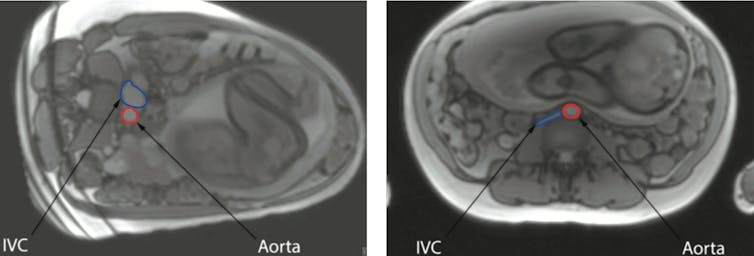
The relationship between the mother going to sleep lying on her back and stillbirth is biologically plausible. A supine position in late pregnancy is associated with reduced blood flow to the womb. Hence, women in labour and women having a caesarean section are routinely tilted onto their side to improve blood supply to the baby.Recent research carried out at the University of Auckland has provided sophisticated evidence about how the mothers’ position influences blood flow. Results obtained using Magnetic Resonance Imaging (MRI) demonstrate the major vessel in the mother’s abdomen, the inferior vena cava, being compressed by the pregnant womb when she is lying on her back. This reduces flow through this vessel by 80%.The MRI images show the inferior vena cava (IVC) in blue and the aorta in red. In the left image, the mother is lying on her left side, while in the right image, she is on her back.provided, CC BY-SA
Although the mother’s circulation responds by increasing the flow through other veins, this does not fully compensate. The mother’s aorta, the main artery which carries oxygen-rich blood from her heart, is also partly compressed when the mother lies on her back. This decreases blood flow to the pregnant uterus, placenta and baby.We speculate that while healthy unborn babies can compensate for the reduced blood supply, babies that are unwell or vulnerable for some other reason may not cope. For example, our mega study showed that the risk of stillbirth after 28 weeks of pregnancy is increased approximately 16 times if a mother goes to sleep lying on her back and also is pregnant with a very small baby.
What to do
New Zealand research has shown that pregnant women can change their sleeping position. In a recent survey conducted in pregnant women from south Auckland, a community that has a high rate of stillbirth, more than 80% of women surveyed stated that they could change the position they went to sleep in with little difficulty if it was best for their baby.Our advice to pregnant women from 28 weeks of pregnancy is to settle to sleep on their side to reduce the risk of stillbirth, and to start every sleep, including day-time naps, on the side. It does not matter which side. It is common to wake up on the back, but we recommend that if this happens, women should simply roll back on to either side.Lesley McCowan, Professor, Obstetrics & Gynecology, University of Auckland and Robin Cronin, Midwife researcher, University of AucklandThis article is republished from The Conversation under a Creative Commons license. Read the original article.
Working as little as even two night shifts a week significantly increases a woman’s risk of miscarriage, Danish researchers say.Based on their analysis of data from a cohort of over 22,000 pregnant women primarily employed at hospitals, researchers found those women who worked two or more night shifts the previous week were 32% more like to have a miscarriage after week eight of their pregnancy, compared to women who did not work night shifts.In addition, increasing the number of night shifts and the number of consecutive night shifts during weeks three to 21 increased the risk of miscarriage even further in a dose-dependent manner.Interestingly, the study found no association between miscarriage and quick returns after a night shift (eg doing an evening shift after having completed a night shift the night before).The study findings, published recently in BMJ publication, Occupational and Environmental Medicine, support previous research that suggested a link between working nights and miscarriage. But previous studies had been limited by a lack of detailed data about the women’s exposure to night work which had meant the link between cause and effect could not be confirmed.Miscarriages are known to be very common with the researchers quoting the estimate that about one third of all human embryos are lost, most of them soon after conception. They also quote the figure that more than half of all miscarriages are the result of chromosomal abnormalities in the fetus.The finding of the association between night work and miscarriage at week eight supports the hypothesis that it is the environmental exposure that is the risk factor, as miscarriages associated with chromosomal abnormalities have generally occurred earlier in the pregnancy.Night work is believed to be a threat to the viability of pregnancies because of its effect on maternal levels of endogenous melatonin, a hormone thought to play a role in optimal function of the placenta. Exposure to light at night along with the disruption of the normal circadian sleep-wake cycles associated with night work both decrease melatonin release.The study potentially has significant implications and ramifications.“This new knowledge has relevance for working pregnant women as well as their employers, physicians and midwifes,” the study authors said.“Moreover, the results could have implications for national occupational health regulations,” they concluded.
Reference
Begtrup LM, Specht IO, Hammer PEC, Flachs EM, Garde AH, Hansen J, et al. Night work and miscarriage: a Danish nationwide register-based cohort study. Occup Environ Med. 2019 Mar 29. DOI: 10.1136/oemed-2018-105592 [epub ahead of print]
Abortion is a common experience for Australian women. Around one in six have had an abortion by their mid-30s, according our new research published today in the Australia New Zealand Journal of Public Health.Narratives about abortion often stigmatise women who have had one or seek access to one. But our research shows women from all walks of life may have an abortion: married, single, child-free, and mothers. In fact, women who have already had children are more likely to have a termination than those who haven’t.Women make decisions about whether or not to have an abortion in the context of their complex lives. And it’s by no means an easy decision.Our research investigated the factors associated with abortion as women move from their late teens into their mid-30s. We found women with lower levels of control over their reproductive health, whether through family violence, drug use or ineffective contraception, are more likely than their peers to terminate a pregnancy.If we want to reduce the rate of unintended pregnancies and abortion in Australia, we need to empower women to have control over their fertility and support them with appropriate health services.
Women’s experiences
We used data from five surveys of the Australian Longitudinal Study on Women’s Health to examine factors associated with “induced” abortions which were not undertaken because of a foetal abnormality.We looked at a cohort of more than 9,000 women born between 1973-78 who were first surveyed at ages 18-23 years. At the fifth survey they were aged 31-36 years.Overall, by their mid-30s, 16% of the women in this study had reported at least one abortion.We also looked at the proportion of women who reported a new abortion at each survey. At the first survey, when women were aged 18-23, 7% reported having had an abortion. In subsequent surveys, 2-3% of women reported having an abortion since the last survey. While most women reported only one new abortion, around one in ten reported two abortions, and around 2% reported three abortions.Abortion is understandably more common for women when they are in their 20s than it is when women reach their 30s. This may be because many women in their 30s are actively trying to be pregnant, or may be using contraception more effectively if they’re trying to avoid becoming pregnant.Compared with married women, those who were in a de facto relationship, were single, or divorced were more likely to have had an abortion.Women with children were more likely to have an abortion than women who did not have children. In the fourth survey, the majority of women (72%) said they hoped to have one or two children, 20% wanted three or more, while 8% didn’t want to have children.Perhaps unsurprisingly, women who had an abortion in the later surveys were more likely to have previously reported using ineffective contraception, or to have had a past abortion, than women who didn’t terminate a pregnancy in their 30s.Women whose alcohol use had recently become riskier and women who reported using any illicit drugs in the past 12 months were also more likely to have an abortion.Violence was also a big factor. Women who recently experienced partner violence were more likely to terminate a pregnancy than women who reported no violence. Even women who reported childhood sexual abuse had a significantly increased likelihood of abortion in their twenties (but not in their 30s).In fact, women reporting violence of any kind, and at any time, had a significantly increased likelihood of having an abortion.
What can we do about it?
Australia is going through a much-needed process of law reform to ensure women across the country have access to abortions as part their women’s health service. Queensland is the most recent state to remove abortion from the criminal code.Alongside this, we need to improve training and resources to for health providers to identify and help women who may be at risk of unintended pregnancy, particularly those who are using illicit drugs or are experiencing partner violence.We need better ways of reaching all vulnerable women, but especially young women experiencing reproductive coercion.We also need to ensure that all women are provided with good access to information about effective contraceptive choices. While the oral contraceptive pill and condoms are the most common methods Australian women use, long-acting reversible methods (such as intra-uterine devices and implants) can be good options for many women wanting effective contraception.
It appears we might still be failing some of our poorer migrant women, with new study finding that they have higher rates of stillbirth compared to Australian-born mothers.Analysing data from stillbirths that occurred in Western Australia over the period 2005 to 2013, researchers found that while stillbirth rates overall were low and often much lower than in these migrant women’s country of birth, they were higher in non-Australian born women, especially in those women who were born in Africa.Published recently in The Medical Journal of Australia, the study also took note of whether the deaths occurred in the antepartum period (between 20 weeks gestation up to before labour commences) or the intrapartum period (which is the period after labour has started), in an attempt to determine when and in whom intervention might be warranted.Researchers found the key factor was the woman’s country of birth rather than her ethnic origin, as there appeared no difference in stillbirth rates among white and non-white Australian-born women.However, women born in Africa were twice as likely to have a stillbirth in the weeks before going into labour compared with Australian-born women. And Indian-born women were 70% more likely. Migrant women born in other countries collectively had an increased risk of about 40% of an antepartum stillbirth.And frighteningly, it appeared the rates of stillbirth occurring once labour had started were also much higher than that which occurs in Australian born women. Almost twice the risk for most migrant women, and more than double that again for African-born women.“That the rate intrapartum stillbirth was twice as high among African women is especially worrying, as intrapartum stillbirth is regarded as preventable and indicative of inadequate quality of care,” the study authors wrote.So why is this happening, the researchers asked. Why is it, that, despite access to the same standard of healthcare as the rest of the Australian population, these women are more at risk of losing their babies, especially African-born women and especially so late in the pregnancy?The study authors suggest cultural issues may play a major role. They point to statistics that show African-born women are more likely to have pregnancies lasting 42 weeks or more, a well-recognised risk factor for stillbirth.Qualitative studies have also determined there is often, particularly among African-born women, a deeply-held suspicion of interventions in pregnancy believing them to interfere with the natural process of childbirth and possibly having long-term repercussions. Consequently, there is not only a poorer attention to antenatal care but also a resistance to procedures such as induction of labour and caesarean section.“More in-depth investigation of the patterns of health service use, pregnancy, and labour care for migrant women, particularly African migrants, is warranted,” the researchers said.They suggest education is the most likely solution, but the changing of what is likely to be long-held and culturally-associated attitudes will need both sensitivity and intelligence.“Culturally appropriate antenatal engagement and educational programs about the risk of stillbirth and the indications for and the safety of induction and related interventions may be useful preventive strategies,” they concluded.
Reference
Mozooni M, Preen DB, Pennell CE. Stillbirth in Western Australia, 2005–2013: the influence of maternal migration and ethnic origin. Med J Aust. 2018; 209(9): 394-400. DOI 10.5694/mja18.00362
Non-Invasive Prenatal Testing (NIPT), the cell-free DNA-based blood test that screens for fetal chromosomal abnormalities, is fast becoming a routine part of obstetric care.NIPT at a glanceDuring pregnancy, maternal plasma contains fragments of DNA from the mother and from the placenta (fetal DNA).The proportion of DNA fragments from particular chromosomes is usually very stable throughout pregnancy. If there is an excess of fetal fragments from one chromosome, the proportion of fragments from that chromosome will be changed.Inconclusive testsA key reason that NIPTs should precisely measures the amount of fetal DNA in the sample – the fetal fraction – is if there is insufficient fetal DNA, the result may merely reflect the genetic status of the mother.NIPT assays should report a result only if there is sufficient fetal DNA to be confident of accuracy.Rarely, a test for trisomy 21,18 and 13 cannot be reported.This occurs in 3% of women tested by Sonic Genetics and is usually because there is insufficient fetal DNA compared with maternal DNA in the mother’s plasma.This low fetal fraction can be due to a relative excess of maternal DNA and this can vary over time. It is more common in women with increased body weight, and more likely in the presence of infection and inflammation, or after exercise.It also occurs if the mother or fetus has some subtle benign variations in chromosome structure (copy number variants) that make estimating the proportion of fragments from a chromosome unreliable.In some instances, the DNA in the sample has degraded during collection and shipping to the laboratory, and the quality is insufficient for a reliable result. These factors interfere with quality control of the test.Two thirds of women will get a result on re-testing.However, if the second test is inconclusive, it should not be repeated. This occurs in 1% of pregnant women screened.It is also not worth using another form of non-invasive prenatal test. Other tests do not estimate the fetal fraction accurately and may provide false reassurance.A decision about other test modalities (combined first trimester screen, second trimester serum screen, detailed ultrasonography or invasive genetic testing such as CVS/amniocentesis) should be based on assessment of all identified risk factors and may require specialist consultation.More rarely (in 0.5 –1% of women) the test reports a result for trisomy 21, 18 and 13 but not for fetal gender and sex chromosome abnormalities. It is unlikely that a repeat test will provide a result. A decision about using fetal ultrasound or invasive genetic testing to document fetal gender should be based on assessment of need and any identified risk factors. General Practice Pathology is a new regular column each authored by an Australian expert pathologist on a topic of particular relevance and interest to practising GPs.The authors provide this editorial, free of charge as part of an educational initiative developed and coordinated by Sonic Pathology.
Among low-risk, nulliparous women, inducing a pregnancy at 39 weeks will not only be at least as safe as letting nature run its course but it will reduce the risk of having a Caesarean, according to US research.According to the randomised trial involving over 6000 women, those who were assigned to ‘expectant management’ ended up having a median gestational age of 40 weeks exactly, not a huge difference from the median gestational age of the induction group which was 39.3 weeks.However, the main aim of the study was to determine if induction at 39 weeks resulted in more adverse perinatal outcomes including conditions such as perinatal death, need for respiratory support, Apgars of less than three at five minutes, intracranial haemorrhage and the like.This potential association has been the concern which has dictated what is currently common obstetric practice.“When gestation is between 39 weeks 0 days and 40 weeks 6 days, common practice has been to avoid elective labour induction because of a lack of evidence of perinatal benefit and concern about a higher frequency of Caesarean delivery and other possible adverse maternal outcomes, particularly among nulliparous women”, the study authors said in the new England Journal of Medicine.What they found in their study however, was that these adverse perinatal outcomes occurred in only 4.3% of the babies born in the induction group and in 5.4% of those born to mothers who went into labour naturally. It appears the relative risk was reduced by 20%. And even though the induction group tended to have longer labours they had quicker recovery times and shorter hospital stays.In terms of maternal outcomes, induction at 39 weeks was associated with a significant reduction in the risk of both Caesarean section and hypertensive disorders of pregnancies. The researchers estimated one Caesarean would be avoided for every 28 low-risk, first-time mothers induced at 39 weeks.The study authors suggest that these findings have the capacity to change practice, or at the very least, provide evidence to relook at current obstetric practice policies.“These results suggest that policies aimed at the avoidance of elective labour induction among low-risk nulliparous women at 39 weeks of gestation are unlikely to reduce the rate of Caesarean delivery on a population level”, they concluded.Ref:NEJM 2018; 379:513-23DOI: 10.1056/NEJMoa1800566
Based on an interview with Associate Professor Kirsten Black and Clinical Associate Professor Deborah Bateson conducted at the Annual Women’s and Children’s Health Update, Sydney in February 2018."Heavy menstrual bleeding" is the new term for menorrhagia.This under-treated condition is easy to screen for in general practice. And screening for it is important as, apart from the discomfort, inconvenience, disturbed sleep, embarrassment and expense heavy menstrual bleeding causes, it is a major cause of iron deficiency in women.Common causes of heavy menstrual bleeding include hormonal variations relating to menarche and menopause, polycystic ovarian syndrome, polyps, fibroids and coagulation disorders.Identifying heavy menstrual bleeding initially involves discussing menstrual patterns with patients, as the diagnosis relies on the subjective experience of the woman as it affects her physical, emotional, social and/or material quality of life.Women may be unsure whether their periods are abnormally heavy compared with other women. Questions that may assist in the diagnosis of heavy menstrual bleeding include asking whether a woman needs to wear both a pad and a tampon simultaneously to prevent leakage, whether she has to use super pads and/or tampons and needs to change them every three hours or less, , whether she is concerned about flooding or staining during the day and avoids social activities as a result, whether she regularly takes time off work at the time of her period, whether she has to get up several times overnight to change her pad or tampon, whether she frequently passes clots (often this is associated with significant period pain), and finally, how the issue is affecting her quality of life.It is also important to inquire about associated symptoms such as pain, bloating and feelings of pressure on the bladder or bowel.Investigations usually include iron studies, a full blood count and a pelvic ultrasound. Ideally the ultrasound should be transvaginal as well as transabdominal. Also, ideally the ultrasound should be conducted between days five to 10 of the menstrual cycle, as this is when the uterine lining is less echogenic and scanning at this time reduces the chance of missing lesions such as polyps, within the uterine cavity. It should be noted that heavy menstrual bleeding may be a symptom of malignancy, especially in women over the age of 45 years.Other more specialised tests may also be indicated, such as coagulation studies, if there is suggestion of a bleeding diathesis.Once malignancy has been excluded as a cause of the bleeding, management usually includes hormonal control of the ovulation cycle, such as with the combined oral contraceptives. These reduce bleeding by 30%.An excellent alternative is the hormonal intrauterine system (Mirena®).If the woman prefers not to use such methods and is not at risk of pregnancy, tranexamic acid or norethisterone, 5mg three times daily, from days five to 26 of the menstrual cycle, can be used.NSAIDS such as mefenamic acid are most effective if commenced just prior to the onset of bleeding and continued into the first few days.Surgical management of heavy menstrual bleeding is usually indicated for women who have completed their families. The less invasive options include endometrial ablation and embolisation of fibroids.Hysterectomy is generally reserved for women in whom less invasive treatments have been unsuccessful, where there is a particular indication (such as large fibroids causing pressure symptoms) or less commonly, at the woman’s request.
Based on an interview with Melbourne urologist, Dr Caroline Dowling conducted in March, 2018Australia was the first country to ban vaginal mesh products used surgically via transvaginal implantation for the treatment of pelvic organ prolapse.Australia was also a leader in evaluating the complications of these implant, through large scale research.1On November 28th 2017, the Therapeutic Goods Administration withdrew implants for use in prolapse, stating it “was of the belief that the benefits of using transvaginal mesh products in the treatment of pelvic organ prolapse do not outweigh the risks these products pose to patients”.There are unique risks related to mesh use. These include mesh erosion (up to 14% of cases)1, vaginal and groin pain (up to 3% to 4%)1 and mesh exposure. These complications may be more common and more severe (requiring surgery) if the mesh is used for prolapse repair, as opposed to the treatment of stress incontinence.Reports of complications associated with transvaginal mesh products began over a decade, with the Food and Drug Administration issuing an alert about their use back in 2008. Repeated warnings were then given. In 2013, legal action began in Australia with 300 women registering for a national class action against Johnson & Johnson Medical Australia.So what do GPs tell their patients who have a vaginal mesh in situ, and what alternative managements are there for vaginal prolapse and stress incontinence?Patients who feel they have complications should be reviewed by the surgeon who operated on them, but it worth noting that most women have had no problems with these products and so, in the absence of symptoms may be reassured that they need no further management.“Women who have no problems from their transvaginal mesh implants should be reassured that they do not require them to be removed,” says Melbourne urologist Dr Caroline DowlingThere is not an inherent risk with mesh as an implant, it is used widely in general surgery for inguinal hernia and abdominal wound repair. Nonetheless, it would be wise to explain the possible side-effects of the vaginal mesh in case these occur in the future.Alternatives to the vaginal mesh implant are the traditional vaginal prolapse repair using native tissue, and these are effective procedures for most women seeking surgical treatment of their prolapse.There are several alternatives to mesh for the treatment of stress incontinence that has failed conservative therapy, including an autologous fascial sling, bulking agents and Burch colposuspension.In 2015, the Cochrane Incontinence Group concluded that mid-urethral slings were highly effective in the short-term and medium-term and had a good safety profile.The mid-urethral sling remains available in its retropubic and transobturator form, but patients can no longer access mini-slings or single incision slings outside trial settings. This may change once the results of longer term studies become available. Single incisions may have a more favourable side-effect profile than full-length slings.More conservative management includes pelvic floor exercises and silicon pessaries inserted for prolapse and stress incontinence treatment.Pelvic floor exercises may be difficult to do effectively and repeatedly for many women, especially over time. They may also be less effective in cases of significant cystocoele.Silicon pessaries are particularly useful in women who are symptomatic but wish to have further pregnancies, in women who do not want surgery, in the elderly and for those in poor health.3 Patients may need help with the insertion and correct placement, but pessaries work well and may be an underutilised option.
Post-menopausal women experiencing vulvovaginal symptoms will benefit just as much from using the cheapest over-the-counter lubricant or moisturiser as using topical oestrogen, a new study suggests.The 12-week randomised clinical trial, published in JAMA Internal Medicine, compared the efficacy of a low-dose vaginal oestradiol tablet and a vaginal moisturiser, each versus placebo among a group of over 300 post-menopausal women with moderate to severe vulvovaginal symptoms.To determine the effectiveness of the treatment women were asked to report on the severity of their ‘most bothersome symptom’ which included pain with vaginal penetration (60%), dryness (21%), itching (7%), irritation (6%) and pain (5%).Across the board, regardless of which treatment was used, most women had a decrease of at least 50% in symptom severity over the course of the study. This was significant in light of the fact that most women said they ‘frequently’ or ‘always’ distressed about their sex life at enrolment, whereas after the 12-week study nearly half said they were ‘rarely’ or ‘never’ distressed.“No treatment group differences in symptom reduction were observed for vaginal oestradiol tablet plus placebo gel vs dual placebo, or vaginal moisturiser plus placebo tablet vs dual placebo”, the US researchers reported.And it didn’t matter if the most bothersome symptom was dyspareunia or itching, it appeared the hormone treatment or the specific vaginal moisturiser (Replens) had no advantage over the placebo combination.According to the study authors, the placebo gel used in the study had a similar pH and viscosity as the vaginal moisturiser (Replens) but was less mucoadhesive. The fact that both formulations were equally effective in reducing symptoms suggests that the mucoadhesive properties are less important than previously thought.Similarly, markers of vaginal oestrogenisation such as the vaginal maturation index, did, naturally improve more with the topical oestrogen but this did not translate into a greater benefit in terms of symptoms over placebo.As an accompanying editorial points out, “ultimately, it is improvement in symptoms rather than surrogates such as tissue markers that should define the goal of care.”And while the study authors conclude that treatment choice for women with troublesome postmenopausal vulvovaginal symptoms should be ‘based on individual patient preferences regarding cost and formulation’ the editorial authors go in much stronger.“[P]ostmenopausal women experiencing vulvovaginal symptoms should choose the cheapest moisturiser or lubricant available over the counter – at least until new evidence arises to suggest there is any benefit to doing otherwise.”Ref:JAMA Intern Med. doi:10.1001/jamainternmed.2018.0116
JAMA Intern Med. doi:10.1001/jamainternmed.2018.0094
The increasing BMI of first-time pregnant women is behind a rise in adverse perinatal outcomes over a 25 year time period, a new retrospective Australian study suggests.Analysing data from one major Sydney teaching hospital, researchers found that the prevalence of overweight among women having their first baby increased from 12.7% in 1990-94 to 16.4% in 2010-14, and that of obesity rose from 4.8% to 7.3%.More importantly they found this increase in BMI was associated with a range of adverse perinatal outcomes particularly pre-eclampsia, macrosomia and gestational diabetes. Other complications believed to have increased as a result of the maternal weight gain included caesarean deliveries, post partum haemorrhage, prematurity, admission to the special care nursery and fetal abnormalities.“We found that a substantial proportion of the burden of adverse perinatal outcomes for Australian women is linked to maternal overweight and obesity, and that this proportion has steadily increased over the past 25 years,” the Sydney researchers said.The study involved the analysis of the data recorded on over 42000 singleton births delivered to previously nulliparous women at the Royal Prince Alfred Hospital Sydney between 1990 and 2014.Interestingly over the course of the study period, the mean age for first time mothers rose from 28.7 to 31.6 years, however having adjusted for this as well as other possible confounders such as changing smoking rates, socioeconomic status, and country of birth of the mother the findings confirmed the relative risks of adverse perinatal outcomes had increased in association with rising prevalence of overweight and obesity.Researchers calculated that should overweight or obese women move down one BMI category (for example from obese to overweight) 19% of pre-eclampsia, 15.9% of macrosomia and 14.2% of gestational diabetes could be averted.“Our results indicate that the frequency of adverse perinatal outcomes could be reduced by shifting the distribution of overweight and obesity among first-time mothers by a single BMI class.Investing in obesity prevention strategies that target women prior to their becoming pregnant is likely to provide the greatest benefit,” they concluded.Ref: MJA doi:10.5694/mja17.00344
Many Australian women with endometriosis are reporting they’re being advised a reliable treatment or even possible cure for their endometriosis is to “go away and have a baby”. This message is consistent with what women from other countries are also being told by a wide range of sources from self-help books to web forums to medical professionals.Pregnancy as a natural cure for endometriosis appears to date back to the early 20th century. However, even into the 1950s and 1960s, when pregnancy was commonly recommended as a treatment for endometriosis, this evidence was based mostly on case reports of women whose endometriosis improved during pregnancy. Case reports are often unusual findings and don’t necessarily reflect what happens to most people.Pregnancy as a treatment for endometriosis does not appear in current international guidelines for the management of endometriosis. It’s also not mentioned as a treatment by Australian pelvic pain specialists and is classed as a “myth” by reputable endometriosis supportsites.Read more: Women with endometriosis need support, not judgement
Endometriosis and the lack of a cure
Endometriosis is the presence of tissue similar to the lining of the uterus outside the uterus itself. Accurate estimates of how many women in Australia have endometriosis are hard to find, but a common figure is around one in ten women during their reproductive years.While severe pain during the period is a common symptom of endometriosis, it’s so much more than just a “really bad period”. There’s almost no area of women’s lives that is not negatively affected by the condition.Current medical treatments, often using hormone therapy, are not always effective. And the side effects of many of the hormonal treatments can be particularly unpleasant for women, leading them to stop treatment.Excision surgery, in which the endometrial lesions are cut away, is the most effective current treatment. But surgery is not something most women enter into lightly, given the cost and risk of undergoing surgery. Unfortunately, even surgery is not always successful with around 50% of women having symptoms reoccur after five years.When we look at women around the world, it looks like having children does decrease the amount of period pain women have. A significant problem with this is we don’t know if these women had endometriosis, and these kinds of studies can’t tell us for sure if getting pregnant was responsible for this reduction in period pain.Read more: Women aren’t responsible for endometriosis, nor should they be expected to cure themselves
Pregnancy, pain and the brain
Women with endometriosis, like other chronic pain conditions, have changes in the way their brains process pain. Nerves, especially in the pelvis, are also more sensitive than in women without chronic pain. The concept of “calming” these hyperactive pain pathways is an important treatment strategy in treating chronic endometriosis pain. Each time menstruation occurs it irritates these sensitive nerves and reinforces these pain pathways.One way to prevent this reinforcement of pain pathways can be by stopping regular menstruation entirely. This is a key reason women with endometriosis are so often treated with continuous use of hormonal contraceptives.During pregnancy there’s also a suppression of menstruation. So it’s possible during pregnancy there will be a reduction in endometriosis-related pain. It’s also just as possible pregnancy will make endometriosis-related pain worse, due to extra pressure on these sensitive pelvic nerves. We just don’t have the research to be able to answer this.Read more - Health Check: are painful periods normal?After giving birth, it’s quite possible the pain, if it had decreased, will return. This is especially true once women start having regular periods again, as there’s no evidence pregnancy shrinks endometrial lesions or changes pain processing in the long term, both major drivers of endometriosis pain.
Should pregnancy be recommended as a treatment?
Pregnancy might help reduce endometriosis symptoms, if only temporarily. But women with endometriosis often rightly feel upset and offended when advised to have a baby as a treatment strategy.There are also risks involved, as women with endometriosis are more likely to have pre-term births, increased rates of caesarean sections and an increased risk of miscarriage.Women shouldn’t have to bring another human into the world to relieve the pain of endometriosis. This is why we need to prioritise understanding the cause of endometriosis, finding effective treatments and eventually a cure.Syl Freedman, Co-founder EndoActive, M.A. Health Communication, MPhil (Medicine) Candidate, University of Sydney contributed to this article.Mike Armour, Post-doctoral research fellow in women's health,NICM, Western Sydney UniversityThis article was originally published on The Conversation. Read the original article.
Psychologist; Director, UNSW Ageing Futures Institute; ARC Laureate Fellow; Senior Principal Research Scientist, NeuRA
Scientia Prof Kaarin Anstey translates the WHO's updated 2026 dementia risk-reduction guidelines changes into concrete actions for opportunistic risk assessment and targeted advice in everyday general practice.






 Clinical Articles

 Lesley McCowan, Professor, Obstetrics & Gynecology, University of Auckland and Robin Cronin, Midwife researcher, University of AucklandThis article is republished from The Conversation under a Creative Commons license. Read the original article.














 Syl Freedman, Co-founder EndoActive, M.A. Health Communication, MPhil (Medicine) Candidate, University of Sydney contributed to this article.