




Labor’s latest pre-election promise to publish the fees of non-GP specialists will likely help patients’ find a specialist they can afford, but GPs are split on whether it will actually compel their specialist colleagues to drop their fees, a Healthed survey this week has found.
On Monday, the Albanese Government announced it would spend $7 million to upgrade the Medical Costs Finder website to include the average fee that every eligible non-GP specialist charged for all common medical services – published alongside the national average.
To do it, they’ll build “technical capability” to analyse annual Medicare, hospital and insurer data for every common medical service, “without asking doctors to spend time on data entry,” the Government said.
Additionally, private health insurers will be required to show their financial arrangements with specialists, as well as disclose how often gap fees aren’t fully covered by patients’ insurance policies.
Since the previous government launched Medical Costs Finder in 2022, a grand total of 70 individual doctors have voluntarily displayed their fees.
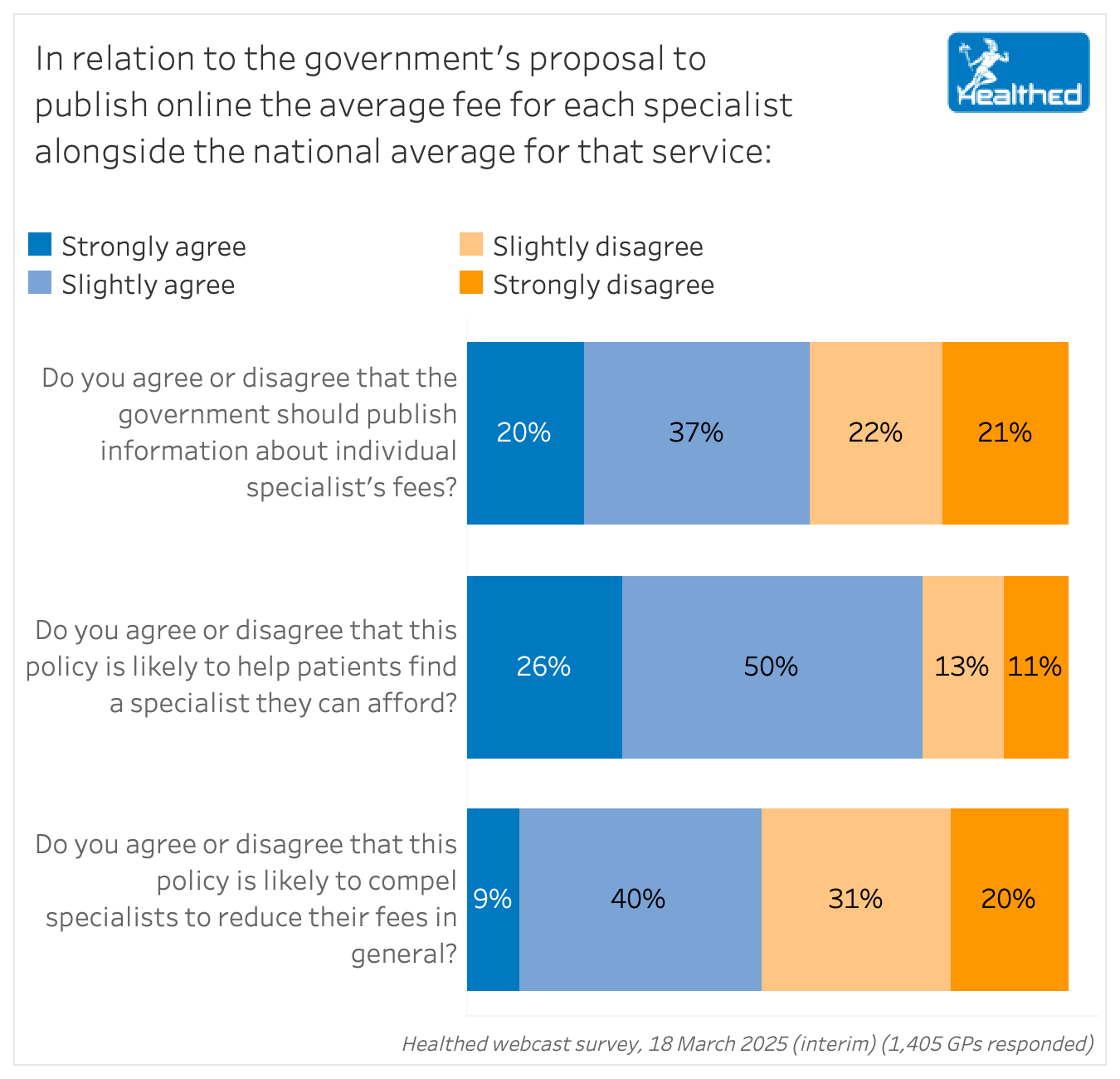
Fifty-seven percent of more than 1400 GPs who have responded to Healthed’s survey so far say they support the Government publishing specialists’ fees.
More than three-quarters say they believe it will help patients find a specialist they can afford. However, when it comes to whether publishing specialists’ fees online will compel doctors to reduce their fees, GPs were less certain – with 49% saying it likely would, and 51% saying it probably would not.
A preliminary analysis of GPs’ free text comments in the survey highlighted several key themes.
About one quarter of GPs who left additional comments felt that “outrageous fees” and “exorbitant out-of-pocket costs” were creating real barriers for patients. These respondents emphasised the role of transparency in supporting informed financial decisions.
“Specialists’ fees do vary widely and cost is often the first question my patients ask me, so having a published list or an estimated fee could save patients (especially pensioners) a lot of time,” one GP noted.
“Specialists charging exorbitant out-of-pocket costs is unacceptable. There should be transparency, and someone should monitor this,” another GP commented.
However, other GPs were more sceptical, with about 16% suggesting listing each specialist’s fees could interfere with their autonomy.
“Specialists, like GPs, should be allowed to set their fees without being subject to an artificial watchdog system,” one GP commented.
“We do not have a government-published list of fees, that I am aware of, for plumbers, lawyers, psychologists etc,” another GP stated.
Other key themes included the correlation between cost and quality (or lackthereof), concerns around feasibility and unintended consequences.
“I’ve noted an interesting phenomenon whereby specialists who are seen to charge more than others may be considered more competent by implication.”
“Higher patient fees do not necessarily mean better health outcomes or patient care.”
“Fees are a consideration for those who have no other options due to financial strain, but they say nothing about bedside manner, treatment efficacy or complication rates.”
“This could backfire like the publishing of CEO incomes in the past, with egos leading to increased, not reduced, fees.”
“Patients are likely to want to go to inferior specialists on the basis they are more affordable.”
“Good luck! Another boondoggle thought of by a pen pusher in a cushy public service job… Unless Medicare is adequately funded, it will ALWAYS be difficult to find affordable care.”
“Specialists in my area have such long waiting times that it will make no difference — patients take who they can get.”
“In rural and remote settings there is no choice of specialists.”
“Average data means nothing to rural and remote patients; they want to know how much the visiting specialist costs vs a trip to the city.”


Browse the latest articles from Healthed.